
Equity Research
Rating: BUY | 12-M Price Target: $420 | Upside: +10% | Current Price: $381
Rating & Price Target
We rate Visa a Buy with a 12-month price target of $420, about 10% above the current price of $381. Add in the small dividend and total expected return is close to 11%. The main idea behind this call is simple: Visa still owns the world's biggest payment network, and it is now growing a second business inside that network - things like fraud protection, advisory services, and real-time money transfers - that grows much faster and earns fatter margins than the old "swipe a card" business. Visa's most recent quarter beat expectations, with revenue up 14% and profit per share up 11% compared to a year earlier. There is a government lawsuit hanging over the stock and travel-related spending growth is slowing a bit, but neither looks serious enough to change the long-term picture. The stock is not cheap, so we are not calling it a screaming buy, but it deserves a place in almost any long-term portfolio.
Our View: We are positive but not extremely excited. Visa's growth story looks solid based on what the company has actually reported, but the stock's price already reflects a lot of good news, so there is less room for the price to jump higher purely because more investors discover the story.
Company Overview & Business Segments
Visa generates revenue through several streams. Service revenue correlates to spending from the prior quarter, making this stream highly predictable, but lags the business by a quarter. Data Processing revenue is the largest bucket and is derived from actually processing the transaction (validating the card, clearing and settling the payment) – this will increase with transaction volume, not necessarily transaction dollar value. International Transaction revenue comes from when consumers spend money in another country or currency, so it will rise and fall with international tourism and commerce. All other revenue includes miscellaneous income like consulting and license fees. Client Incentives are payments that Visa provides to banks to continue using Visa’s network as opposed to a competitor’s network – this is subtracted from revenue, so if it increases, it could reduce profitability.
Value-Added Services (VAS): this is software for fraud prevention, identity validation, consulting services, etc. that banks and merchants pay a premium for separately. Commercial and Money Movement Solutions (CMS) includes Visa Direct, a platform that allows for real-time money movement (e.g. paying a contractor, sending money to family abroad, or a company paying for materials) without needing a card transaction. Each of these segments are growing much quicker than the core network business and now comprise almost a third of total Visa revenue. VisaNet is the technology backbone that processes transactions and is increasingly used to facilitate new forms of payment such as tokenized digital wallets and even early stage stablecoins. .
Our view: Put simply, Visa is transitioning from a toll booth business (earning pennies everytime someone transacts) to a software business with a toll booth. This should allow Visa to expand its profit margins over time, though the company has been reluctant to provide granular numbers on how profitable segments like VAS and CMS are by themselves.
Recent Financial Performance
Two details jumped out at us. First, while strong, growth in VAS has accelerated this quarter, jumping to 34% from slower growth earlier in the year. That acceleration is well ahead of total revenue growth, which came in at around 14%. Second, growth of cross-border volume (money spent in foreign countries, typically associated with travel) slowed to just 15% in the latest quarter from 21% in the prior quarter. That's something to keep an eye on since cross-border spending represents some of Visa's highest margins.
In total, for the past five fiscal years, Visa has seen its revenue grow from approximately $24.1 billion to $40.0 billion, or roughly 13.5% per year. Profits per share have grown at an even faster pace (just over 16% per year) primarily as a result of stock buybacks.
Visa reports GAAP profit as well as what it calls "adjusted" profit. The latter strips out one-time expenses such as legal fees. For any given quarter, the two numbers can be very different. So instead of relying on news reports that may refer to one but report the other, go straight to Visa's reconciliation tables.
Our view: We're inclined to view the deceleration of cross-border volume as the key number to watch. While part of it is simply people traveling and spending less abroad, it coincides with the encouraging VAS narrative, and could dampen some of that enthusiasm if it continues to slow.
Growth Drivers & Strategic Bets
Visa's most obvious source of growth today is Value-Added Services: fraud protection, advisory services, and products that Visa sells to banks. This segment has grown between 27-34% annually for the last several years and now accounts for nearly one-third of total Visa revenue. Visa Direct and CMS connect buyers and sellers for instant-business payments, gig worker payouts, and cross-border transactions. CMS transaction volume grew 23% year-over-year. Cross-border travel and e-commerce continues to drive spending growth, though as mentioned above this growth has slowed in the past couple quarters. Tap-to-pay and expanding tokenized digital wallets also provide growth opportunities in emerging markets where cash is still dominant. Finally, management is investing in stablecoin infrastructure, though even they admit it is a long-term opportunity that will not materially contribute to profits anytime soon.
On the competitive front, longtime rival Mastercard provides stiff competition and frequently goes after the same bank relationships as Visa. Real-time" payment networks that transfer money directly between bank accounts (such as FedNow in the US, Pix in Brazil, and UPI in India) are growing in their respective countries and could eat into the use of card networks like Visa for domestic payments over time, although cross-border payment is where most growth currently occurs and this development hasn't negatively impacted that business. Fintech apps and BNPL services nibble away at card transactions on the margins. The biggest regulatory threat would be legislation that mandates banks allow multiple payment routing options, which would reduce Visa's cut of every transaction. The US government has already filed a lawsuit against Visa for allegedly monopolizing the debit card market.
Our View: We feel great about the VAS/CMS growth story due to four consecutive quarters of strong growth numbers reported directly by the company. We are less sure how quickly stablecoins and real-time payments will begin to eat away at Visa's core businesses, as this is more of an industry-wide projection than something we can quantify today.
Capital Allocation & Balance Sheet
Visa produces large quantities of cash relative to its business expenses. For example, in just the last quarter alone the company produced $6.55 billion of operating cash flow, while spending roughly $417 million on equipment and technology investments (about 3.5% of total revenue), due to the non-physical nature of running a payment network. This cash has allowed Visa to buy back $3.7-$7.9 billion of stock each quarter over the last year, pay roughly $1.15-1.29 billion per quarter in dividends, and still maintain a healthy $12.4 billion cash cushion as of the last quarter while sporting very manageable debt levels compared to equity. The company has also been steered away from large, risky acquisitions under CEO Ryan McInerney and CFO Chris Suh and has instead focused on building-out new capabilities internally or buying small niche companies, all while returning most of its excess cash to shareholders.
Our view: We like this cautious approach that heavily focuses on returning cash to shareholders because it should allow for stable earnings growth moving forward and doesn't risk the company making an expensive blockbuster acquisition that fails to pan out like we've seen with other large corporations.
Competitive Benchmarking
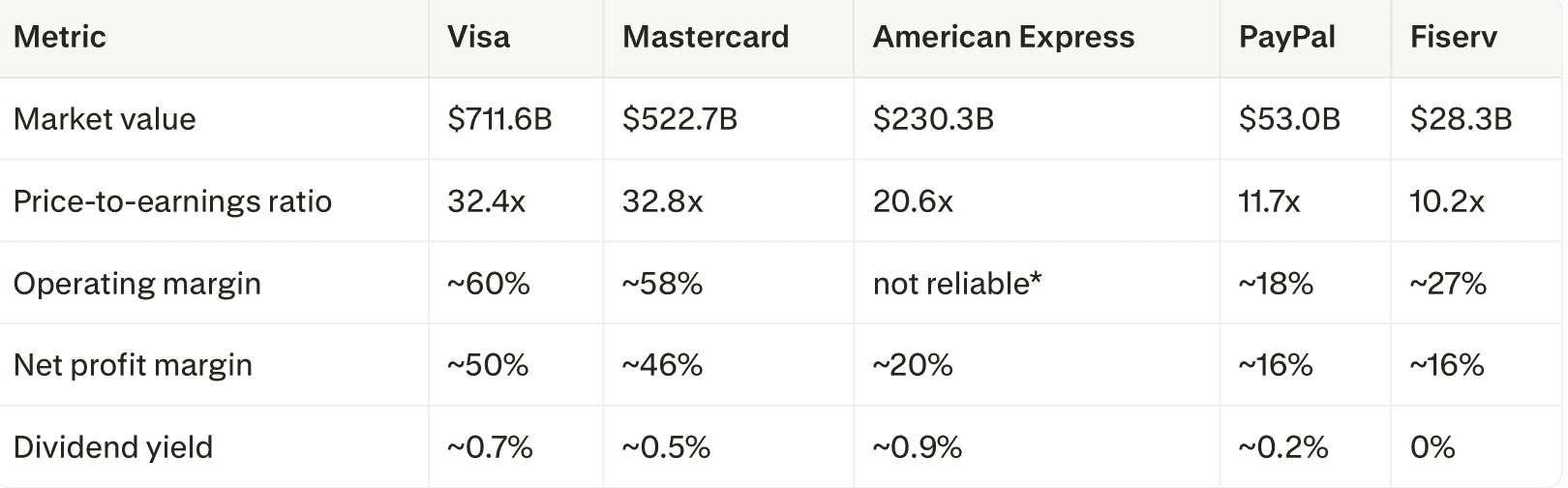

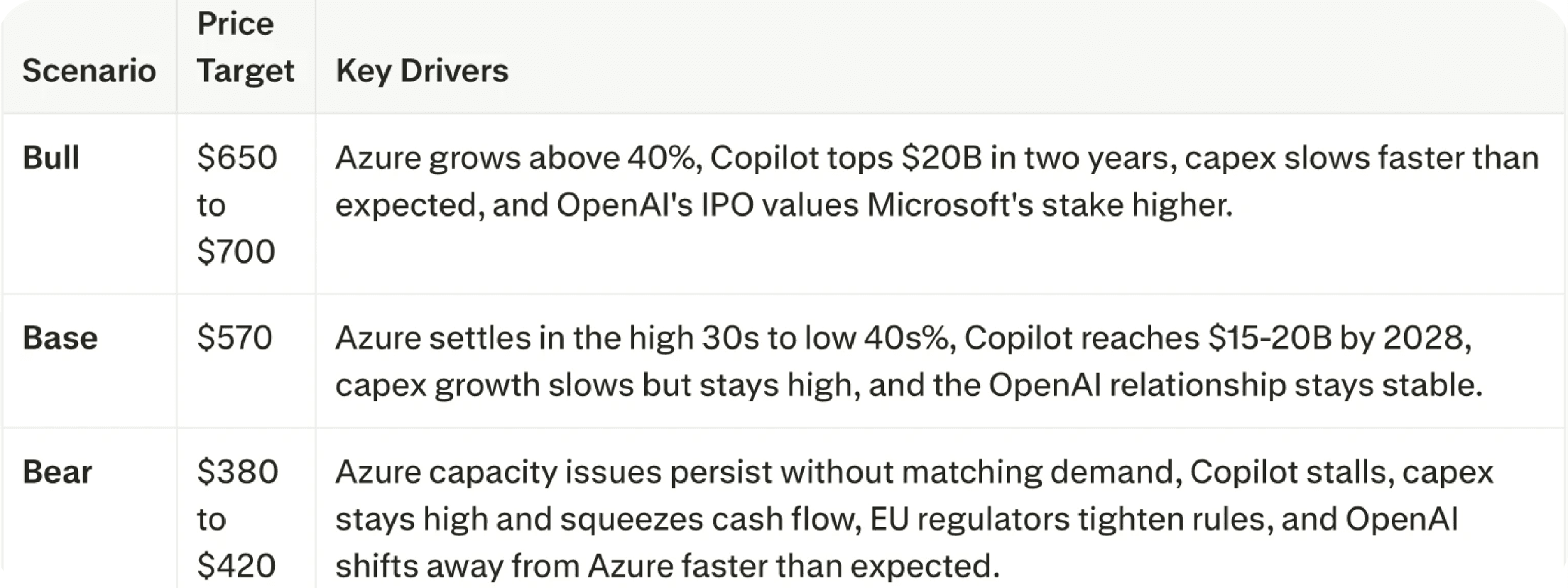
Our View: We believe the base case is most likely (approximately 60% probability) as the past four quarters have all supported this scenario. For the bull case to occur, we would need to see VAS growth accelerate from current expectations. For the bear case to occur, we would need to see either an adverse legal decision or a much sharper economic slowdown than we are forecasting.
Capital Market Signals
Visa is dominated by a handful of large institutional investors. Vanguard Group and BlackRock are two of the largest shareholders and haven't changed their holdings significantly lately. Among Wall Street analysts, buy ratings are exceedingly bullish. Of the past 15 analysts we saw, 14 rated the stock a buy and just 1 was neutral. Price targets ranged from $350 to $450. A few insiders have sold shares over the past few months, including CEO Al Kelly. However, these sales are tied to a large grant of stock awards that vested recently, suggesting the sales were planned well in advance and are not the result of managerial pessimism. Note: Visa has multiple classes of stock, and the voting stock held by the bank members that founded Visa decades ago carries more weight than the shares held by retail investors. While we don't love this set-up, it hasn't negatively impacted shareholders in the past and is unlikely to going forward.
Our view: We don't like stocks where the majority of analysts are already bullish. The reason is that if everyone is recommending you buy a stock, there is less room for good news to push the stock higher. Conversely, there is plenty of room for shares to react poorly if results fall short of Wall Street's expectations, even if they beat analysts' earnings estimates.
Conclusion
Our $420 price target implies a Buy rating and trades about 10% higher than where shares price today. We believe Visa is best suited as a core long-term holding for investors seeking relatively stable exposure to worldwide spending growth.