
Equity Research
Rating: Buy | 12-M Price Target: $155 | Upside: +13% | Current Price: $137
Rating and Price Target
Snacks (Lay’s, Doritos, Quaker) and beverages (Pepsi, Gatorade, Mountain Dew) made by PepsiCo are sold in almost every country on the planet. Today, the stock is trading at a discount to its history and to peer companies such as Coca-Cola , despite faster than expected international snack and beverage volume growth. Essentially, PepsiCo has had soft volume sales in North America snacks for over a year due to changes in snacking behavior caused by weight loss medications known as GLP-1s. Sales outside of North America have been growing between 5% to 9% annually, helping to offset the weakness. A recent development involves activist investor Elliott Management building a $4 billion stake in the company and demanding changes that could potentially unlock value. In our opinion, the shares are cheap enough today to where they likely price in pessimistic volume trends for North America snacks. As such, we like the risk-reward.
Our View: Bullish. We think the gap between PepsiCo's valuation and business challenges are overstated. Medium Confidence. We feel very strongly that there is a valuation gap. We are less sure how quickly North America snacking will recover as it is dependent on the long-term adoption rates of GLP-1s.
Company Overview and Business Segments
Starting in 2025, PepsiCo reorganized into six segments so investors can see where growth and profit are really coming from
One common theme among all of its segments: better- for-you reformulation. Think: healthier chips, higher-protein/additional-whole grains for Quaker, and promoting drinks with zero sugar like Gatorade Zero and Propel. It's PepsiCo's response to consumers adapting their eating habits due to weight-loss medications. The company is also implementing artificial-intelligence equipped tools to better forecast demand and route deliveries, and it has sustainability initiatives it calls pep+ that are doubling as cost-savings programs.
Our View: We like how PepsiCo is splitting itself into six segments. We feel that it will benefit the stock in the long-run because it shows investors how quickly the international business is growing rather than aggregating it into one "rest of world" segment.
Recent Financial Performance
Examining the past five reported quarters (Q2 20-25 through Q2 20-26), PepsiCo has missed Wall Street revenue and earnings estimates zero times. However, the beats have been marginalizing. Adjusted (non-GAAP) earnings per share has ranged from $1.61 to $2.29 per share per quarter, while gross margins have hovered around 54%.
PBCTricity rating
The most obvious trend has been weakness in North America snacks (PFNA), which contracted in three of the last five quarters. To be sure, international businesses have also grown, helping keep overall sales in line with expectations. Specifically, in the most recent quarter (Q2 20-26), PepsiCo's international beverage franchise business grew 9% and its Asia Pacific Foods business grew 9%, fueled by strong growth in China and India. In contrast, PFNA sales contracted 2%.
Most of the company's growth has come from price increases rather than volume gains. Specifically, 70% of EPS growth came from price realization and only 30% from volume/expenses. While that is sustainable for now, we do wonder how long it will last before cost-conscious consumers trade down to store brands.
For the full year 20-26, management is guiding for 2-4% total sales growth (adjusted for currency), 4-6% adjusted earnings per share growth, and believes the majority of the growth will come in the back half of the year. Analysts are expecting revenue to increase from approximately $92 billion in 20-25 to about $99 billion in 20-26 and $102 billion in 20-27, which would represent steady but slow growth.
Our View: We think the weakness in North America snacks could continue for some time, as it has already lasted over a year. We do not believe it is a mirage. We believe it is being driven by fundamental changes in consumer eating habits, especially with the widespread adoption of weight-loss drugs. That being said, we do not view this as a big problem for PepsiCo, as its international business is growing fast enough to offset weaker sales in North America snacks, which has been proven true over the past two quarters.
Growth Drivers & Strategic Bets
Probably PepsiCo's largest growth driver is just that consumers in India, China, LATAM, and Southeast Asia consume less packaged food and beverages per capita than Americans do. Because of this, there is still a lot of room to increase volume as incomes rise in those regions. Within beverages specifically, zero-sugar and "functional" drinks (products centered around hydration, energy, etc.) are growing the fastest, and PepsiCo has been attempting to grow Gatorade Zero and Propel to gain market share in this space, though it still lags behind Monster and Celsius specifically for energy drinks.
PepsiCo is reformulating its chips and snacks to have less sodium and simpler ingredients, and more protein or fiber. The goal is that these products will appeal to both health-conscious consumers and those looking to manage their appetite. It typically takes a few years for changes like this to be fully reflected in top-line sales.
Quaker experienced a nationwide recall late in 2023 due to possible salmonella contamination. The recall led to a class-action settlement, but the brand has seemingly recovered as evidenced by how the broader snacks category is performing.
While PepsiCo has been able to raise prices 3-6% per year across most regions, an increasing number of budget-conscious consumers are trading down to store-brand snacks and soda. If this continues, PepsiCo may struggle to keep increasing prices at current levels. A true structural advantage that PepsiCo has over its peers is its direct-store-delivery model. Basically, PepsiCo uses its own trucks and sales team to stock store shelves. The company is able to respond more quickly to changes in demand and strategically place their products on shelves better than competitors who go through warehouses to restock stores (Mondelez, General Mills).
Our view: We believe the market is overly focused on NA headlines and not paying enough attention to the growth internationally within snacks and beverages. If international sales continue to perform well, this bodes very well for the stock price over the next few years. However, this is a lower confidence view as we only have a couple quarters of the new segment reporting to base this sustainability off of.
Capital Allocation & Balance Sheet
PepsiCo has healthy cash flow, though it is uneven quarter to quarter. In Q1 2026 the company burned cash due to seasonal factors and a large tax payment. Cash flow resumed its healthy pace in the second quarter. For all of 2026, PepsiCo expects to return ~$8.9 billion to shareholders. Most of this will be in the form of dividends (~$7.9 billion), with a comparatively smaller amount (~$1 billion) used for stock buybacks. This is a departure from previous years, where buybacks accounted for a larger share of shareholder payouts.
Like most large beverage companies, PepsiCo is a "Dividend King," meaning it has raised its dividend for 54 consecutive years. This is one of the longest dividend increases streaks in the stock market. However, its dividend payout ratio (percentage of profit paid to shareholders as dividends) rose to approximately 93% in 2025, which leaves little room for future dividend growth if earnings don’t increase.
The company’s leverage is mid-range compared to peers (~2.4x annual cash earnings). This is slightly higher than Coca-Cola but lower than General Mills or Mondelez. PepsiCo’s management under CEO Ramon Laguarta has made smaller "bolt-on" acquisitions in recent years to expand its presence in functional drinks and protein snacks. It has avoided risky large mergers and acquisitions and shed unneeded brands that don’t fit into its core strategy. The biggest uncertainty is whether PepsiCo agrees to "refranchise" some of its North American bottling business at the urging of Elliott Management. Refranchising these businesses would boost margins in the beverage business on paper by moving expensive manufacturing operations to franchise partners.
Our View: PepsiCo's commitment to maintain its dividend is commendable and important to income-seeking shareholders. However, the reduction in the buyback program signals to us that PepsiCo has less financial flexibility than it did in prior years. We are only moderately confident that a bottler refranchising deal will get done in the near future. The company has not made any official announcements about such a plan.
Competitive Benchmarking


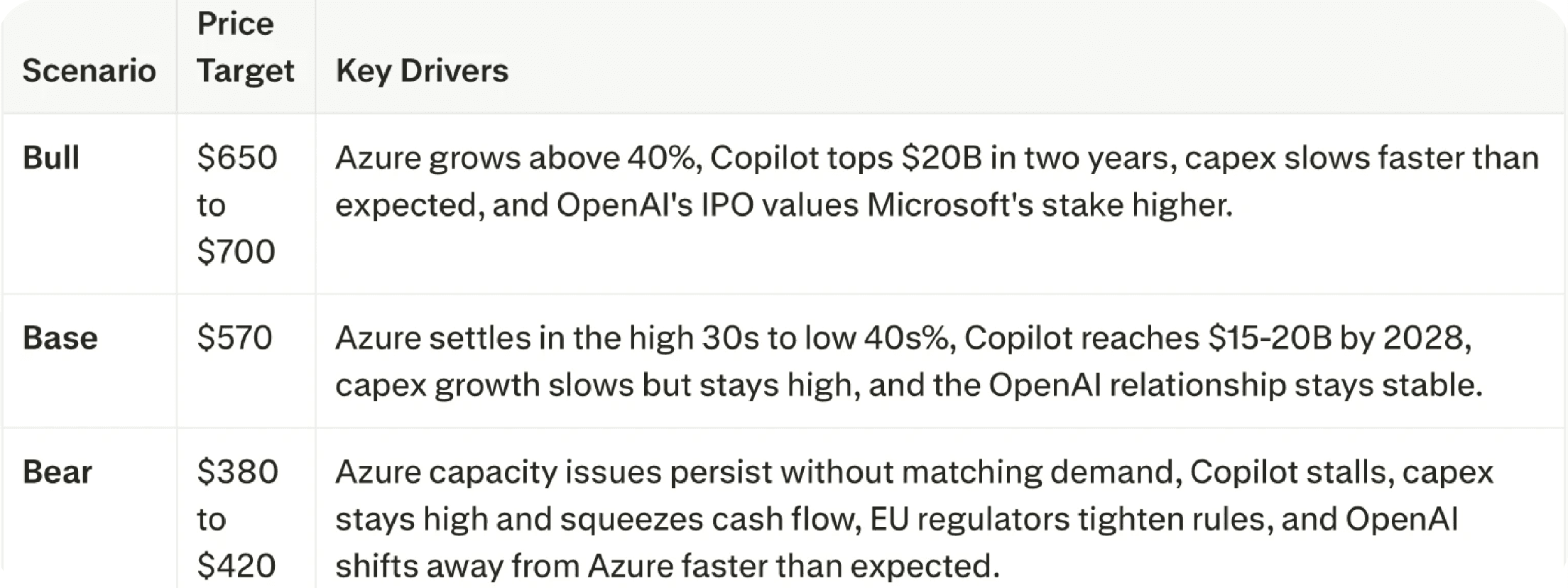
Our view: We favor the base case scenario unfolding (about 60% chance we see), but obviously the bull/bear cases rely on two factors: Does Elliott's push for change result in actionable decisions? and How quickly do weight-loss drugs impact snack volume moving forward?
Wall Street Sentiment and Ownership
PepsiCo's biggest investors are large index funds BlackRock, Vanguard, and State Street. All three increased their holdings recently by small amounts, but this is likely due to passive index investing rather than a conviction about the stock. The real news is that hedge fund Elliott Management now holds about $4 billion in PepsiCo stock, which it disclosed in September 2025. Elliott has publicly stated it thinks the stock could climb over 50% higher if PepsiCo implements the changes it is requesting.
Insiders at the company have not been buying or selling stock outside of normal payroll-related activity. Wall Street analysts have no clear consensus either. 14 analysts have issued ratings on PepsiCo. 5 rate it a buy and 9 rate it neutral. There are no sell ratings. The average analyst price target is $161.50, but estimates range from $140 to $183. This wide range suggests that analysts really aren't sure how quickly the company will turn around.
Our View: Analysts staying out of this stock rather than giving it a thumbs up or down is a sign that the market is waiting for more concrete information before making a decision. We believe this presents an opportunity for investors because any good news (whether on Elliott's plan or improved sales in North America) could sway analysts to turn bullish, which would send the stock price higher.
Conclusion
We rate PepsiCo a Buy with a $155 price target, meaning we expect roughly 13% price growth plus its 4% dividend, for a total return near 17% over the next year. PepsiCo fits well as a core, stable holding for long-term investors who want steady dividend income, given its 50-plus year streak of raising dividends and diversified global business.