
Equity Research
Rating: BUY | 12-M Price Target: $95 | Upside: +19% | Current Price: $79.6
Rating and Price Target
Our Netflix price target is $95. We rate Netflix BUY. That is 19% higher than current levels and in line with Wall Street expectations.
We believe Netflix is dominating the “streaming wars.” Netflix has the largest global subscriber base, increasing profit margins, and its new ad-supported tier is evolving into a sizable, likely billions of dollars, business in its own right. Shares are down over one-third from 2025 highs as investors reacted to slowing growth, a botched quarter, and an infamous aborted takeover attempt. We think these reactions have been overblown and are primarily driven by sentiment rather than a business collapsing. Netflix continues to repurchase shares at a robust pace and has a strong balance sheet.
Our view: The recent sell-off has left shares undervalued compared to where they were a year ago. Even famous investor Bill Ackman bought shares of Netflix again recently after famously losing money on the stock and vowing never to buy it again. While this isn’t a small factor in our decision, we do not view this as concrete evidence by any means.
How Netflix Makes Money
Netflix generates revenue in four primary ways.
Subscriptions. You know this. Netflix provides numbers for subscriptions it gets from four regions: US and Canada (UCAN), Europe/ME/Africa (EMEA), Latin America (LATAM), and Asia-Pacific (APAC). UCAN accounted for $5.43 billion in revenue last quarter, EMEA $4.03 billion, LATAM $1.58 billion, and APAC $1.51 billion. Netflix stopped disclosing subscriber totals to investors each quarter, so analysts now focus on revenue growth and hours viewed as leading indicators.
Advertising. Netflix’s ad-supported plan was introduced in 2022 and now has around 250 million people reach every month globally. That’s up from 190 million just one year ago. Management expects nearly $3 billion in revenue from advertising this year. Rather than partner exclusively with other companies to serve up ads to its subscribers, Netflix built its own ad-tech stack so it can control prices and targeting.
Content licensing. Netflix licenses shows to other people, and produces content for other platforms. This still makes up a tiny fraction of Netflix’s total business, however.
Extras: games, live events, merchandise. Netflix has dipped its toes into mobile gaming related to its shows. More importantly, it is getting into live sports and events. Netflix paid more than $5 billion in year-long deal with WWE for “Raw.” Additionally, Netflix is paying the NFL to show games that were not previously available on other streaming services through the 2029-30 season. Netflix has also broadcast boxing matches.
Building the platform to support everything else. Three other items are worth mentioning because they underpin Netflix’s ability to do all of the above. First, its recommendation algorithm retains viewers better and lowers cancellations. Netflix has had years of data to build this out over more than a decade. Second, Netflix’s crackdown on “password sharing” converted free-riding moochers into paying customers. Third, Netflix has developed the technology to serve live events that can accommodate millions of concurrent viewers, which is different than Netflix’s usual on-demand product.
Our view: Netflix’s advertising and live sports initiatives will have the biggest impact on Netflix’s future. They allow Netflix to earn money from advertising that it previously would not have been able to capture. While we like the long-term vision, we aren’t as sure about how quickly Netflix will be able to execute. There have been few details provided about how profitable its ad business will be.
Recent Financial Performance
Netflix’s Q1 2026 net income and EPS got inflated by a significant one-time item: Warner Bros. Discovery sued Netflix for withdrawing from a deal where WBD was bought by Netflix; Netflix settled and paid WBD $2.8 billion in damages. If you back that out, Netflix would have reported a decline in earnings from year-ago levels (though they still would have likely missed estimates for the quarter, due to increased costs). Double-check the precise adjusted figure with Netflix’s actual filings, as some sources report slightly different figures than others.
Revenue growth is slowing across-the-board, but some regions are slowing faster than others. One year ago, international segments grew (currency-adjusted) 15% in UCAN, 16% in EMEA, 23% in LATAM, and 23% in APAC. Now they are growing 10%, 11%, 16%, and 18%. Growth is decelerating everywhere, but UCAN and EMEA are trending towards Netflix’s long-term forecast of low single-digit growth since those markets are the most saturated. APAC and LATAM still have lots of growth potential left.
Guidance. Netflix’s guidance for revenue growth in the current quarter is approximately 11-12%. The company updated its revenue guidance for full year 2026 to approximately $51 billion, which is slightly disappointing.
Longer-term outlook. Revenue grew from $39.0 billion in 2024 to $45.2 billion in 2025. We expect it to grow to about $51.2 billion in 2026 and $57.0 billion in 2027. Netflix is still growing rapidly, it’s just no longer growing as quickly as it used to.
Our view. We view Netflix’s slowing growth in mature markets as a predictable structural change, rather than as a cause for concern. Netflix’s largest markets can’t logically grow at high rates forever, so near-term growth will come from price hikes and advertising revenue instead of new customers alone. Profit margins look healthy to us, but please remember to parse out one-time charges so you can evaluate Netflix’s underlying business.
Growth Drivers and Big Bets
Advertising tier. Netflix has about 250 million people watching ads every month already. If priced right, this could be a lucrative supplemental revenue source once Netflix realizes it, since those people are already paying for Netflix through normal subscription fees.
Live sports. NFL and WWE will help keep Netflix competitive with traditional cable offerings and capture live viewers it would otherwise lose to cable, and live events also draw advertisers.
Password-sharing crackdown. This provided a strong one-time lift and we think it's already happened. The crackdown is largely over and done with at this point so there won't be much future impact from it.
International growth. Netflix's subscriber growth outside the US has slowed dramatically, but APAC in particular remains its biggest growth region. There is still plenty of room to grow internationally.
Gaming. Netflix's foray into mobile games feels like more of a tool for subscriber retention than a revenue source at this point.
Spending discipline. Simply means Netflix says it will be smarter with how it spends money on content. It doesn't have to spend billions on every new show.
Competition. Rivals like Disney+, Amazon Prime Video, and yes, even YouTube are going after the same viewers and ad dollars. YouTube is giant: it pulled in over $60 billion in combined revenue in 20 25 alone, more than Netflix's entire revenue base. $40 billion of YouTube's revenues were advertising dollars. YouTube's advertising business alone dwarfs Netflix's projected ad business. That is why we consider YouTube, which is a completely different product than Netflix by the way (i.e. free versus subscription-based, user-generated videos versus professionally produced shows), Netflix's biggest competitor for ad revenue and viewer attention.
Our View: The advertising and sports initiatives make sense for Netflix, but it's a bit late to the party compared to the giants of the advertising world. Netflix's biggest challenge over the next few years is proving it can convert its massive audience into meaningful advertising revenue quickly enough to make a difference, without losing tons of cash on sports licensing deals.
How Netflix Spends and Manages Its Money
Netflix produced about $11 billion in free cash flow over the last year. It also does not have large capital expenditures (capex) because it does not own a lot of physical equipment – most of its cash is spent on content, which is accounted for differently on the income statement.
Netflix bought back $4.7 billion of its own stock in the second quarter of 20 26 alone, the largest buyback quarter in its history. It still has approximately $27 billion remaining in buyback authority. Netflix does not pay a dividend and has preferred buybacks as its shareholder return method.
Balance Sheet: Netflix cash totaled $9.1 billion at the end of Q2 2026, and long-term debt has decreased from $14.5 billion a year ago to $11.8 billion today. Netflix has relatively low debt levels when compared to its earnings, compared to most in the media industry.
Warner Bros. Discovery buyout. Netflix’s largest capital expenditure over the last year was not actually spent on buying another company. Netflix had a signed agreement to buy Warner Bros. Discovery, but another company (Paramount Skydance) outbid Netflix. As a “signing bonus” for Warner Bros. Discovery, Netflix received $2.8 billion for forfeiting the deal. Led by Co-CEOs Ted Sarandos and Greg Peters, and CFO Spencer Neumann, Netflix decided it was best not to engage in a bidding war and took the cash off the table instead.
Our View: We think this was a wise and disciplined decision. Netflix could have over-paid for a company full of legacy television assets that are likely shrinking each year. Instead, Netflix received billions of dollars in cash, which it used to repurchase its own stock. We would much rather see Netflix do small tuck-in deals for sports rights or content libraries than make another massive bet on another company.
How Netflix Compares to Competitors
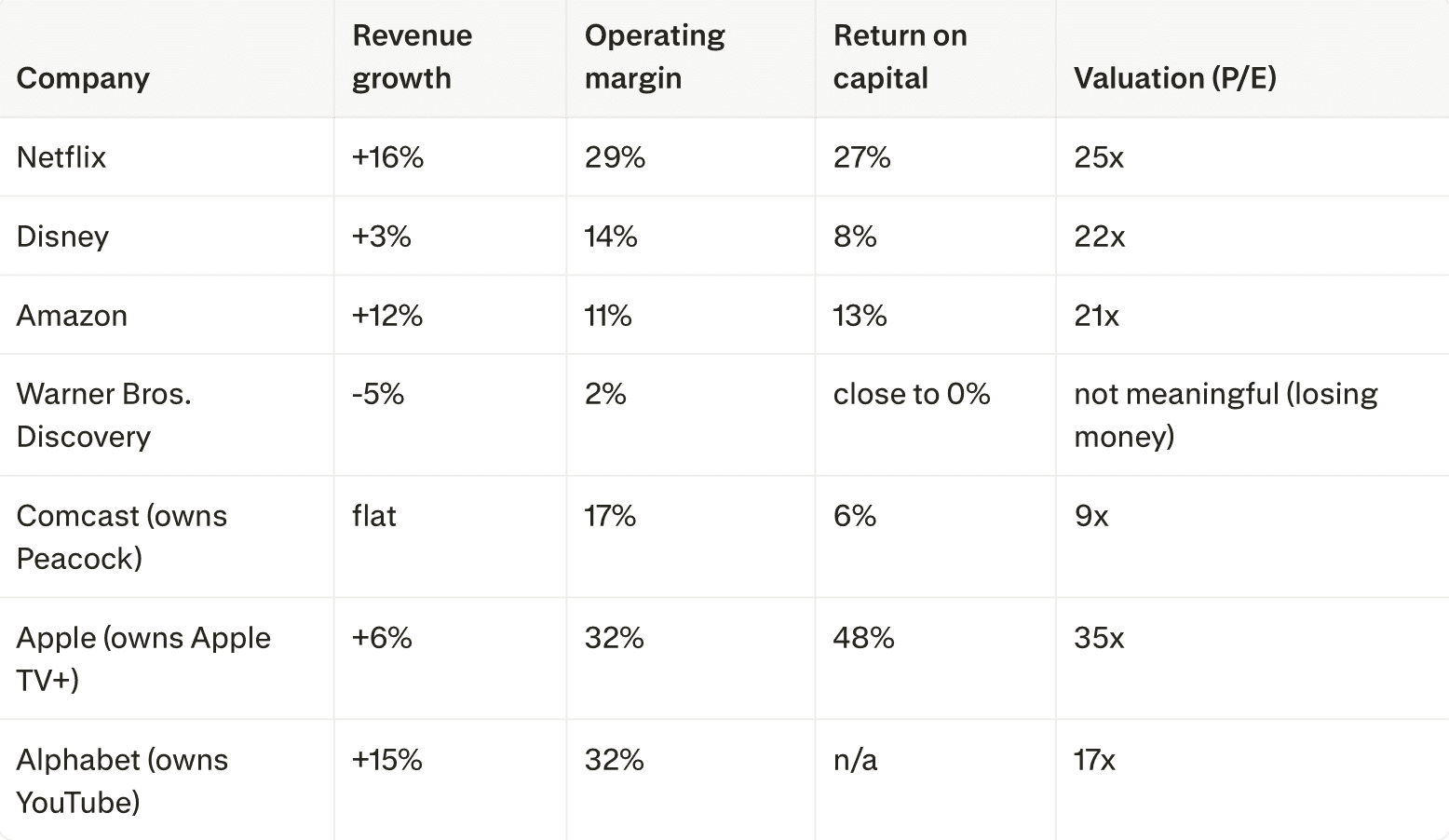

The biggest investors in Netflix are large index-fund organizations like BlackRock, Vanguard, and State Street. This is typical of most large, established stocks. As of this writing, most Wall Street analysts have given Netflix a rating of "Strong Buy". Targets range from as low as $70 all the way to $125, with the average target around $91. Some banks have recently cut their targets slightly following Netflix's latest earnings release, but have maintained their bull ratings. We view this as encouraging news, as it shows short-term caution without an loss of long-term confidence.
Netflix CFO Spencer Neumann and Co-CEO Greg Peters have sold shares of the company recently, but their behavior is consistent with pre-planned selling that is part of their compensation packages. Our data did not confirm any recent trading by Co-CEO Ted Sarandos or founder Reed Hastings. Users relying on this information should confirm with Netflix's filings.
Prominent hedge fund manager Bill Ackman opened a new position in Netflix, with close to 5% of his fund now invested in Netflix. Ackman's previous position in Netflix was acquired years ago and lost money for him.
Our View: We see mixed signals in slightly lowered price targets and continued "buy" ratings, but when a well respected investor renews confidence in a stock we pay attention. We believe the market is lowering their short term expectations, but still sees the big picture which is similar to our view.
Conclusion
We rate Netflix BUY and assign a $95 price target, 19% above current levels. Netflix is appropriate for investors seeking large-cap, well-known media and technology companies that will continue to grow earnings despite decelerating subscriber growth. One to two years is an appropriate holding period to allow enough time to see the payoffs of the advertising business and investments in live sports play out clearly.